
Applies to: OpsLogix VMware Management Pack (all versions) · SCOM 2019, 2022, 2025 · vCenter 7.0, 8.0, 9.0
Last updated: October 2026 · Reading time: 1 minute
Goal
Assign a license to each ESXi host you want to monitor. Only hosts with a license are discovered and monitored in SCOM.
Prerequisites
- A license key imported in the OpsLogix License Dashboard. See Import the VMware MP license key.
- A vCenter or ESXi connection added in VMware MP Configuration.
- All servers in the VMware resource pool are available. Update sends the assignments to every one of them.
Steps
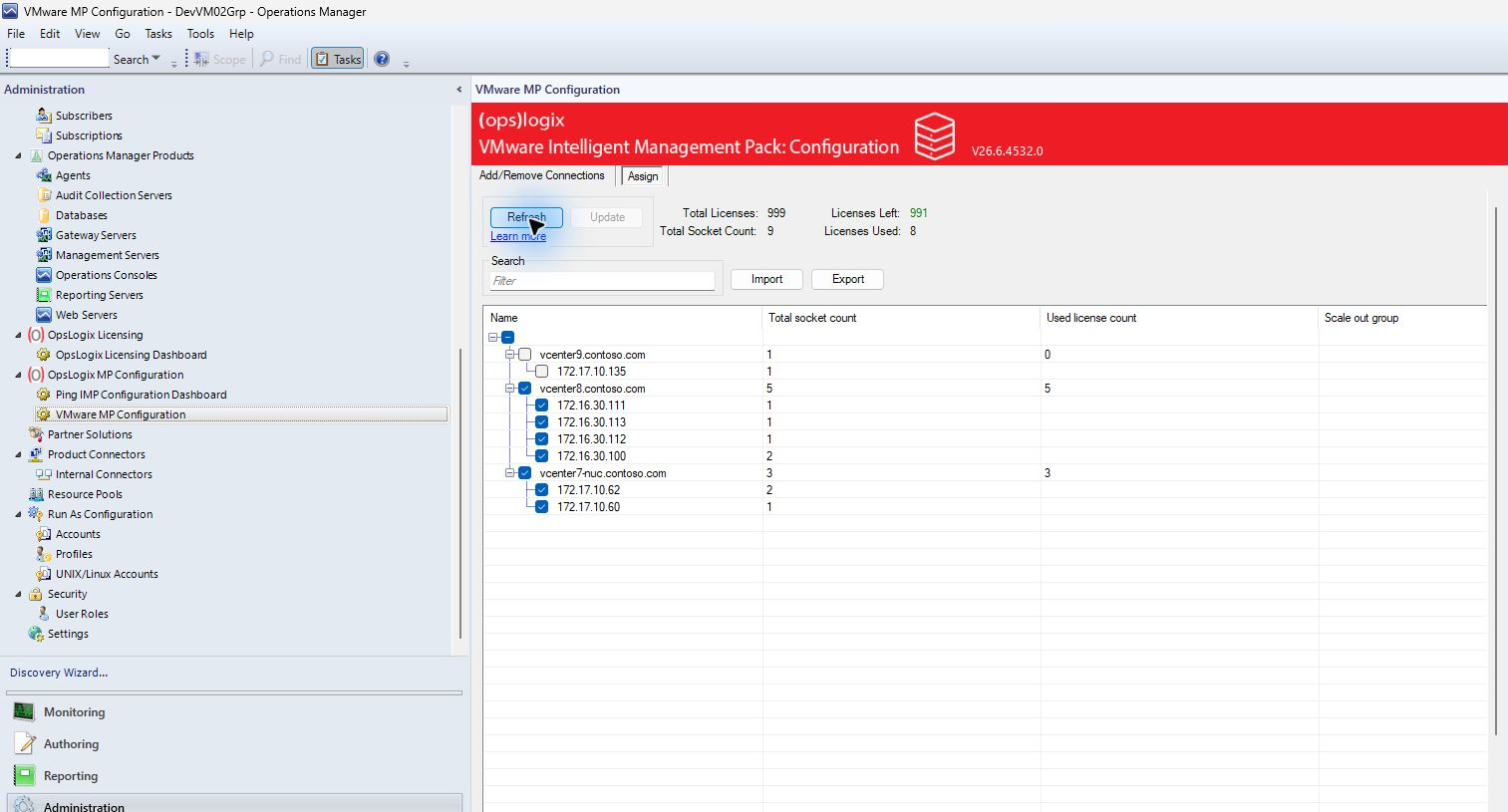
- Go to Administration > OpsLogix MP Configuration > VMware MP Configuration and open the Assign tab.
- If the host list is empty, click Refresh and wait for the hosts to appear.
- Select the hosts you want to license. Each host uses one license for every physical CPU socket. The totals at the top of the tab show how many licenses you have, use and have left.
- Click Update to save the assignments. Update only becomes available after you change a selection, and stays unavailable while the selected hosts need more licenses than you have.
Socket count shows "?": if vCenter doesn't report the number of sockets for a host, the totals show ? and you can't select hosts. Check that all hosts are connected in vCenter, then click Refresh.
Verify it worked
The selected hosts stay selected after you refresh the list, and the license totals at the top of the tab are updated. The hosts and their components are then discovered in SCOM. See How long does discovery take?
Assign licenses automatically
Applies to: OpsLogix VMware Management Pack 26.10.4540.0 and later
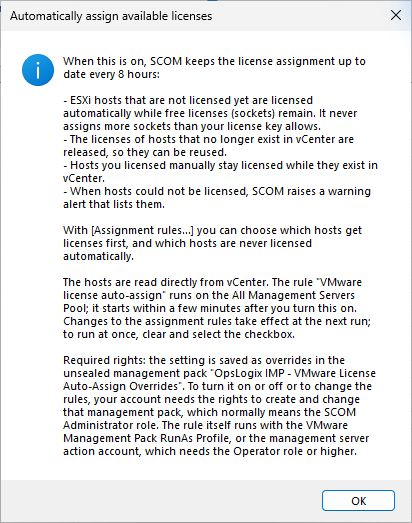
When ESXi hosts are added and removed often, you can let SCOM keep the license assignment up to date. When automatic assignment is on, SCOM does the following every 8 hours:
- It licenses ESXi hosts that are not licensed yet, as long as free licenses (sockets) remain. It never assigns more sockets than your license key allows.
- It releases the licenses of hosts that no longer exist in vCenter, so you can reuse them.
- Hosts you licensed manually stay licensed for as long as they exist in vCenter.
- When hosts could not be licensed, SCOM raises a warning alert that lists them.
SCOM reads the hosts directly from vCenter, so new hosts are found even though they are not discovered in SCOM yet.
Before you start
- Your account needs the rights to create and change management packs, which normally means the SCOM Administrator role. The setting is saved as overrides in the unsealed management pack OpsLogix IMP - VMware License Auto-Assign Overrides, which the dashboard creates for you.
- The assignment runs on the management servers, with the account in the VMware Management Pack RunAs Profile. If the profile has no account, the management server action account is used. This account needs the Operator role or higher in SCOM.
- All management servers in the resource pools of your vCenter connections must be available, the same as for a manual assignment.
Turn on automatic assignment
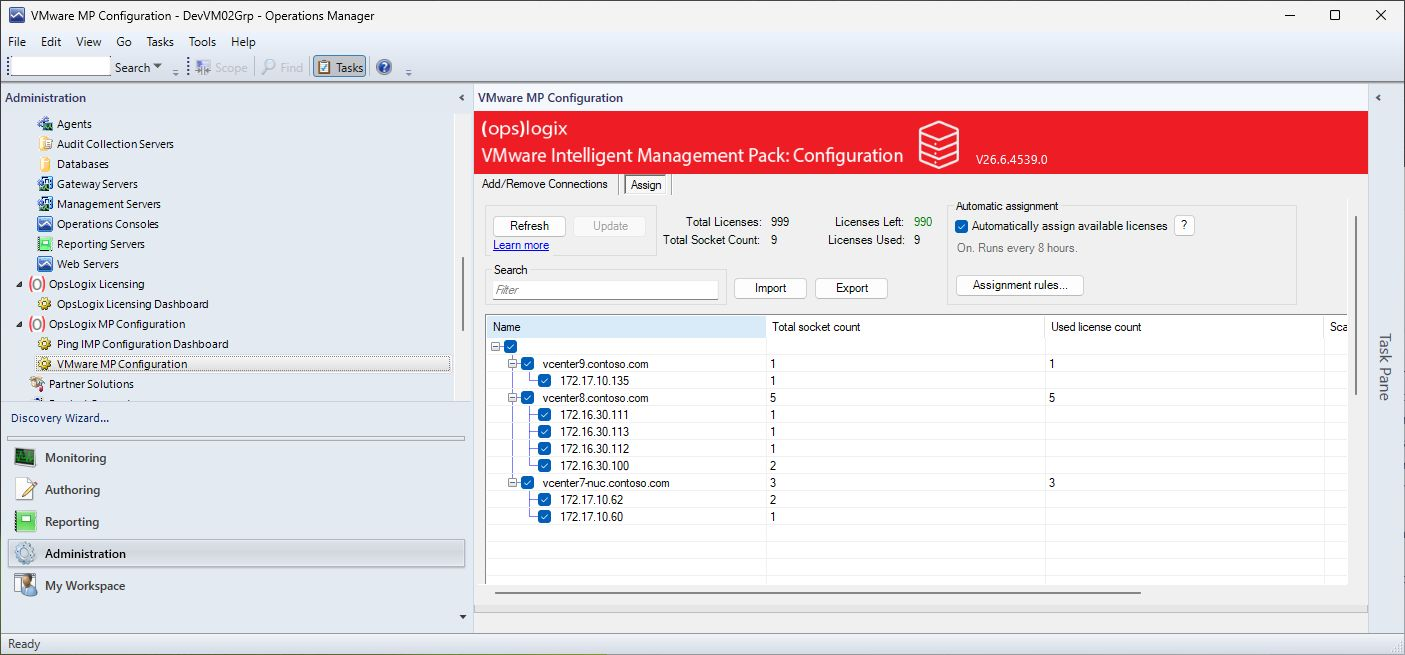
- In the Operations console, go to Administration > OpsLogix MP Configuration > VMware MP Configuration and open the Assign tab.
- Under Automatic assignment, select Automatically assign available licenses. Select ? next to the checkbox for a short explanation.
- Confirm the message. Within a few minutes SCOM runs the first assignment. Select Refresh later to see the result.
To turn it off, clear the checkbox. The licenses that were assigned stay assigned.
Choose which hosts get licenses first
When you don't have enough licenses for every host, you can decide who gets them first. Select Assignment rules.... Changes to the rules take effect at the next run, within 8 hours. To apply them at once, clear and select Automatically assign available licenses.
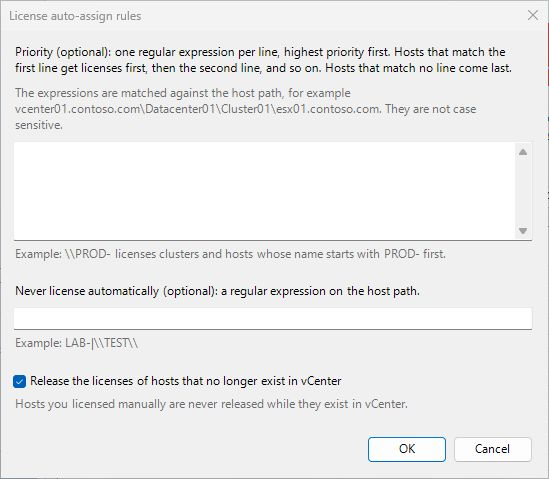
| Setting | Meaning |
| Priority | One regular expression per line, highest priority first. Hosts that match the first line get licenses first, then the second line, and so on. Hosts that match no line come last. Within a line, hosts with fewer sockets come first, so as many hosts as possible are licensed. |
| Never license automatically | A regular expression. Matching hosts are never licensed automatically. You can still license them manually. |
| Release the licenses of hosts that no longer exist in vCenter | On by default. Clear it to release licenses only manually. |
The expressions are matched against the host path, which has the form vcenter01.contoso.com\Datacenter01\Cluster01\esx01.contoso.com. They are not case sensitive. In a regular expression, write a backslash as \\.
| Goal | Rule |
| License the production clusters first | Priority line \\PROD- (clusters and hosts whose name starts with PROD-) |
| License one vCenter before the others | Priority line ^vcenter01\.contoso\.com\\ |
| Never license lab and test hosts automatically | Never license automatically LAB-|\\TEST\\ |
When hosts are not released
For safety, SCOM leaves the licenses of a vCenter connection unchanged in these cases. The warning alert explains which case applies.
- vCenter did not answer, or returned no hosts.
- Two or more of the licensed hosts, and more than half of them, are missing at the same time. That usually means a permission or vCenter problem, not a decommission. If the hosts were really removed, clear them on the Assign tab and select Update.
Hosts in maintenance mode, disconnected hosts and powered-off hosts still exist in vCenter, so they keep their license.
The warning alert
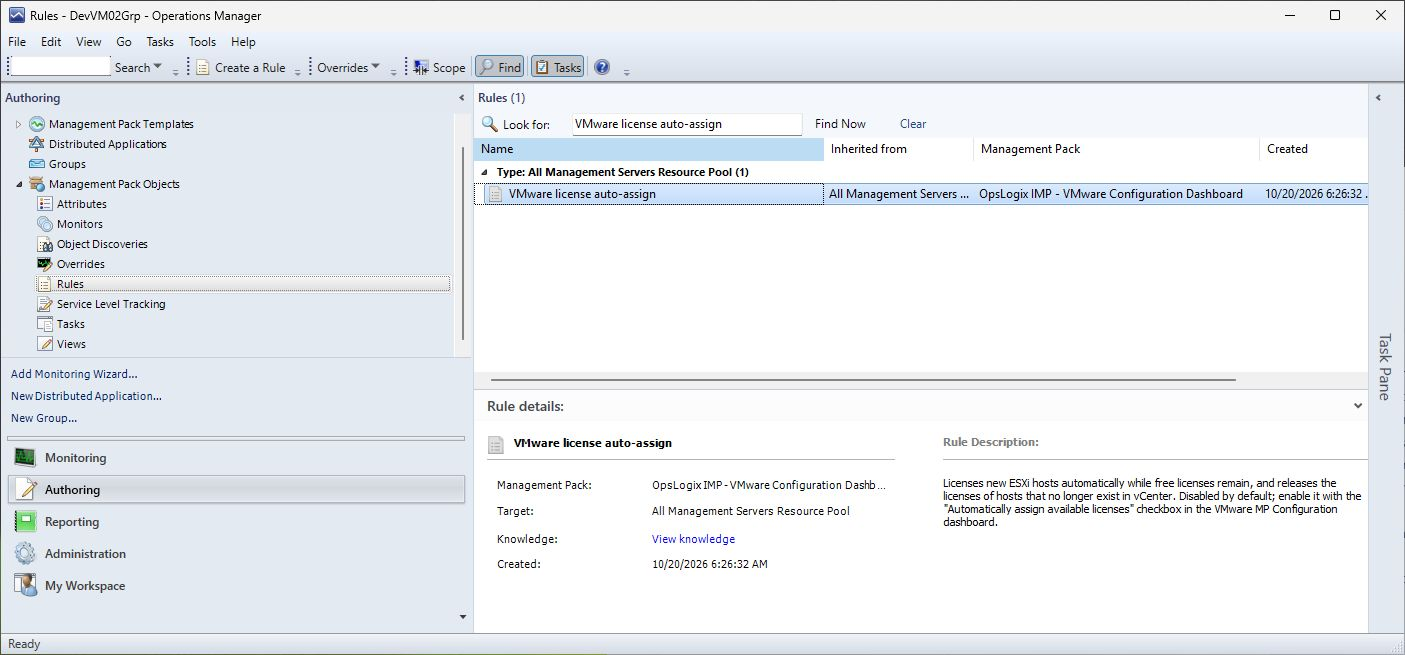
The rule VMware license auto-assign raises the alert VMware license auto-assign needs attention on the All Management Servers Pool. It lists the hosts that could not be licensed and why, for example "not enough free licenses". The alert closes at the next run without problems. Every run also writes event 3890 (no problems) or 3891 (needs attention) with the result to the Operations Manager event log on the management server, with source Opslogix Configuration UI. To resolve it, add licenses to your license key, release hosts you don't need to monitor, or exclude them with Never license automatically.
Change the interval
The rule runs every 8 hours. To change that, override IntervalSeconds on the rule VMware license auto-assign (Authoring > Management Pack Objects > Rules) and store the override in the same management pack.
Use PowerShell
The VMware PowerShell module runs the same assignment on demand. First see what would change, then run it:
Set-SCOMVMwareHostLicences -OpsMgrSDK "scom01.contoso.com" -AutoAssign -WhatIf
Set-SCOMVMwareHostLicences -OpsMgrSDK "scom01.contoso.com" -AutoAssign -PriorityPatterns "\\PROD-;.*" -ExcludePattern "LAB-"
The command returns the hosts that were licensed, released and not licensed. Separate priority patterns with a semicolon.
See also
- Count the CPU sockets in your VMware environment
- Check Connection or Refresh on the Assign tab never finishes
- "OpsLogix VMware license is not valid": update your license